
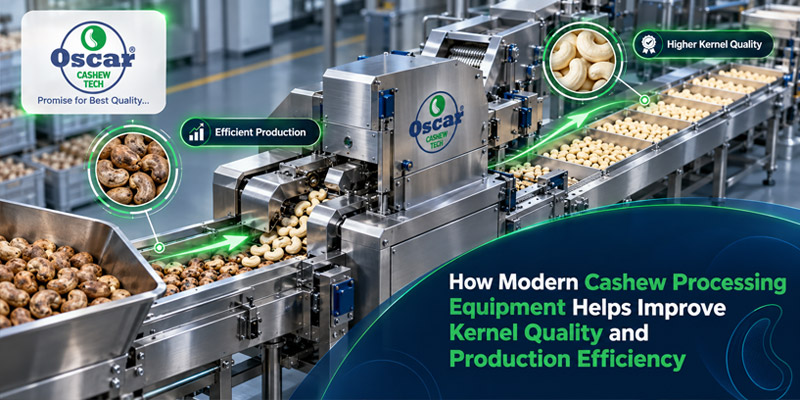
Kernel recovery rate. Ask any experienced cashew processor what keeps them focused and that number comes up quickly. Because the difference between a processing operation running at 60% whole kernel recovery and one running at 75% is not a minor operational detail. Across a full season of processing volume, it is the difference between a profitable business and one that is barely covering its costs.
The cashew goes through a lot between arriving as a raw nut and leaving as a graded kernel ready for market. Cleaning, sizing, steaming or conditioning, shell cutting, shell removal, drying, peeling, grading, and inspection. Each stage is an opportunity to add value, and each stage done poorly is an opportunity to destroy it. Broken kernels command a fraction of the price of whole ones. Inconsistent processing produces inconsistent grades. Inconsistent grades mean lower average realisation per tonne regardless of what the raw material quality was when it arrived.
This is the environment in which modern cashew processing equipment makes its case. Not as a technology upgrade for its own sake. As a direct intervention in the economics of the business.
Where Manual Processing Creates Limits
Skilled workers remain essential in cashew processing. Inspection, quality assessment, specialised handling decisions. Human judgement in these areas is genuinely valuable and machinery does not replace it.
What machinery replaces well is the repetitive, high-volume, physically demanding operations where human variability is the problem rather than the solution. Shell cutting done manually varies with operator fatigue, skill level, and the pace of work through the shift. The same operation done by a properly calibrated machine produces consistent pressure and consistent results from the first nut to the last. The 3 PM output matches the 9 AM output in ways that a manual operation cannot guarantee.
This consistency matters beyond just recovery rates. It makes quality management more predictable. When the process is consistent, quality problems are easier to trace to their source. When every shift and every operator introduces different variables, quality becomes difficult to manage systematically.
Shell Cutting and Kernel Recovery
The shell cutting stage has the greatest single impact on kernel recovery. Too much pressure and the kernel breaks. Too little and the shell is not cleanly opened, which creates problems in the next stage. The pressure required varies with nut size, which is exactly why grading before cutting matters so much, a point covered separately but worth noting here.
Appropriately designed cashew processing machinery for shell cutting applies controlled, calibrated force matched to the nut dimensions being processed. The result is cleaner cuts, less kernel damage, and higher whole kernel yield from the same raw material input.
The actual recovery improvement depends on the machine configuration, raw material characteristics, and how well the equipment is maintained and operated. These are not trivial qualifications. A machine running with worn cutting blades or incorrect settings will not deliver the recovery rates it is capable of. This is why operator training and maintenance discipline matter as much as the equipment specification itself.
Looking to upgrade your cashew processing facility?
Oscar Cashew Tech offers advanced processing equipment engineered for maximum kernel recovery.
Grading and Consistency in the Final Product
Commercial buyers for cashew kernels work to grade specifications. W180, W210, W240 and so on, defined by kernel count per pound and visual quality standards. Delivering a consistent grade across a shipment is what builds and maintains buyer relationships. Delivering mixed or variable grades, even if the average quality is acceptable, creates problems at the receiving end.
Automated grading equipment sorts kernels by size and weight with a consistency that manual grading cannot match at commercial volumes. It also does it faster, which matters for throughput, and without the fatigue effects that affect manual graders through a long shift.
For a processor supplying export markets where grade consistency is part of the contractual specification, this is not an optional capability.
Selecting Equipment That Fits the Facility
Not every processing operation has the same requirements, the same available space, the same power infrastructure, or the same production volume. A fully automated processing line appropriate for a large-scale commercial operation is not the right specification for a mid-sized facility that would be over-capitalised by that investment.
The right approach is matching equipment capability to actual production requirements. Required daily throughput, available floor area, existing equipment that will remain in the line, workforce capability, maintenance infrastructure, and the desired balance between automation and manual operations. A professional cashew processing machine manufacturer who understands processing operations rather than just machine specifications can help work through these decisions.
Phased modernisation is often the most practical path for established processors. Identify the stage in the current line that is the biggest constraint on recovery or throughput. Address that first. Measure the improvement. Then evaluate what the next priority is.
Manufacturer Support Matters beyond the Purchase
The equipment you buy is only as good as the support around it. Installation done correctly from the beginning avoids the kind of problems that take months to trace and correct. Operator training ensures the machine runs at its actual capability rather than at whatever level operators figure out through trial and error. Spare parts availability determines whether a breakdown means a few hours of downtime or a few weeks waiting for components.
These are not supplementary concerns. They are integral to the return on investment the equipment is supposed to deliver.
FAQs
Cleaning, sizing, steaming and conditioning, shell cutting, shell removal, drying, peeling, grading, and quality inspection. The appropriate machine configuration depends on which stages in a specific facility would most benefit from automation or improved capability.
Properly configured and maintained equipment provides more controlled processing than manual operations at the high-volume stages. This translates to reduced breakage in shell cutting and separation when the equipment is appropriate for the raw material being processed.
Start with the production volume requirements and the specific stages creating the most constraint on recovery or throughput. Match equipment capability to those requirements. Factor in space, power, maintenance infrastructure, and the workforce training needed to operate the new equipment effectively.
Because installation quality, operator training, ongoing technical assistance, and parts availability collectively determine whether the equipment delivers its intended performance over its operational life. The machine specification is the starting point, not the whole story.