
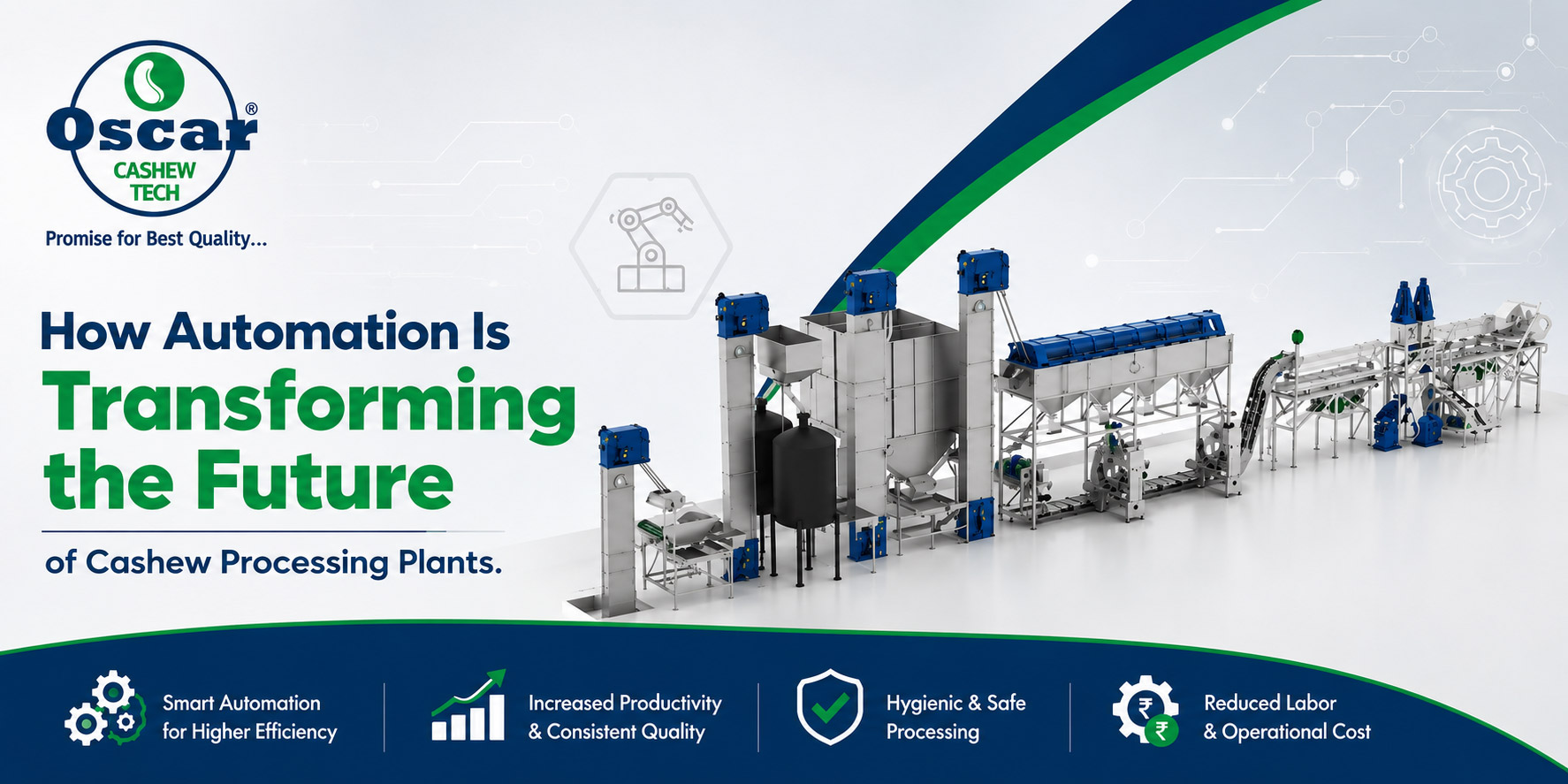
Pose any individual who has been operating a cashew nut processing facility in the conventional way with the question of what troubles them about their business. They will give you their answer quickly without thinking twice – inconsistency in the efficiency of shell removal, kernel damage while peeling the shells off, difficulty in retaining good labour force during the peak season and the fear of having a competitor ahead of them thanks to better machinery.
Automation in cashew processing has moved decisively from 'interesting to watch' to 'hard to ignore.' Global demand for premium-quality kernels continues to climb, buyer quality standards keep tightening, and processors who are still running heavily manual operations are finding that the gap between what they can produce and what the market wants is widening. Investing in a Modern Fully Automatic Cashew Nut Processing Plant isn't a luxury play anymore — it's increasingly the minimum required to stay relevant in a market that doesn't wait for anyone to catch up.
What Manual Processing Actually Costs — Beyond Labour
The visible cost of manual processing is labour. The less visible cost is variability. When people are doing the same task repeatedly across a long shift, output consistency drifts — shell cutting pressure varies, peeling timing changes, grading decisions differ from person to person and hour to hour. The result shows up as kernel breakage rates that are higher than they should be, grade mixing that reduces the value of the output, and batch-to-batch quality that frustrates export buyers who need predictable product.
Automated systems don't get tired, don't speed up to hit a quota at the end of a shift, and don't vary their technique based on how the morning is going. The same settings that produced a clean shell cut at 8 AM will produce the same result at 4 PM. For processors who've experienced the downstream consequences of quality inconsistency — rejected shipments, renegotiated prices, damaged buyer relationships — that reliability is worth a great deal more than its sticker price suggests.
How Modern Equipment Actually Handles the Production Line
The best Cashew Processing Equipment today is designed around the whole workflow, not just individual machines. Automatic grading systems sort incoming raw cashews by size before processing begins — a step that sounds minor but has significant downstream impact, since uniform-sized nuts shell and peel more consistently than a mixed batch. Precision shell cutting machines are calibrated to apply exactly the right force for the nut size, which reduces the kernel damage that eats into recovery rates.
Automated peeling systems handle the testa removal that is one of the most labour-intensive and quality-sensitive steps in the process. Controlled drying — with accurate temperature and humidity management — ensures kernels reach the right moisture content without over-drying that causes brittleness or under-drying that creates shelf life problems. Automated packaging closes the loop by sealing product quickly, hygienically, and consistently without the handling variation that manual packing introduces at the final stage.
Looking to set up an automated cashew processing plant?
Oscar Cashew Tech offers complete turnkey solutions from 1000kg to 100 MT/day capacity.
The Recovery Rate Conversation Nobody Has Loudly Enough
Kernel recovery rate is arguably the single most important economic variable in cashew processing, and it's one of the places where Automation in Cashew Processing Machine systems deliver the clearest, most measurable return. Higher breakage means more pieces and lower grade yields. Even a two or three percentage point improvement in whole kernel recovery across a large production volume translates into meaningful additional revenue per tonne processed.
Automated shell cutting and peeling systems, when properly calibrated for the nut variety and size being processed, consistently outperform manual operations on this metric. For processors who track their numbers carefully, this is often the part of the automation ROI calculation that makes the decision feel straightforward rather than speculative.
Food Safety Is No Longer Optional — And Automation Helps
Questions asked by international purchasers, retail chains, and food safety auditors are becoming tougher than ever before. Traceability, hygiene, contamination control, and processing procedures have become necessary rather than optional in many export destinations. Manual procedures which require a lot of direct handling of products have become an audit risk that cannot be avoided with automation.
Stainless steel construction throughout the processing line, reduced human contact with product during critical stages, and controlled environments that are designed to be cleaned and validated — these aren't marketing points, they're genuine food safety advantages. For processors competing for supply contracts with quality-conscious international buyers, this dimension of automation can be as commercially important as the efficiency gains.
Planning for Scale Without Rebuilding From Scratch
One of the less-discussed advantages of modern automated processing plants is their scalability architecture. The right plant design allows capacity to be expanded — additional lines, higher throughput configurations, upgraded components — without tearing down and rebuilding the facility around the expansion. Processors who plan their initial installation with future growth in mind avoid the expensive disruption of having to essentially re-invest in infrastructure every time the business grows.
A Modern Fully Automatic Cashew Nut Processing Plant built with modular, upgradeable Cashew Processing Equipment gives operators the flexibility to respond to market opportunities as they arise rather than being constrained by infrastructure decisions made years earlier.
The Technology Partner Question
Automation equipment is only as good as the integration behind it. Individual machines performing their specific functions well doesn't guarantee a smooth production line if the handoffs between stages aren't properly designed. The processors who get the most from automation are typically those who worked with a technology partner that understood the complete workflow — not just the specifications of each machine in isolation.
Installation support, operator training, calibration for local nuts, and technical support after installation all go into whether the automated facility will function as intended or spend its first few years under troubleshooting. This should be just as important as the technical specifications of the equipment when making the purchase.
Conclusion
Cashew processing automation has crossed the line from competitive advantage to competitive necessity. The processors who recognised that shift early are now operating at efficiency levels and quality standards that manual operations genuinely can't match. The ones who are still weighing the decision are increasingly doing so in a market that isn't slowing down to wait for them.
Investing in Automation in Cashew Processing Machine technology, building around a Modern Fully Automatic Cashew Nut Processing Plant , and specifying Cashew Processing Equipment that's designed to work as an integrated system rather than a collection of individual machines — these are the decisions that separate processing operations built for the next decade from those still managing the constraints of the last one.